
Iza Aldana
Feb 25, 2026
Senator warns bypassing Philippine courts could erode due process and sovereignty
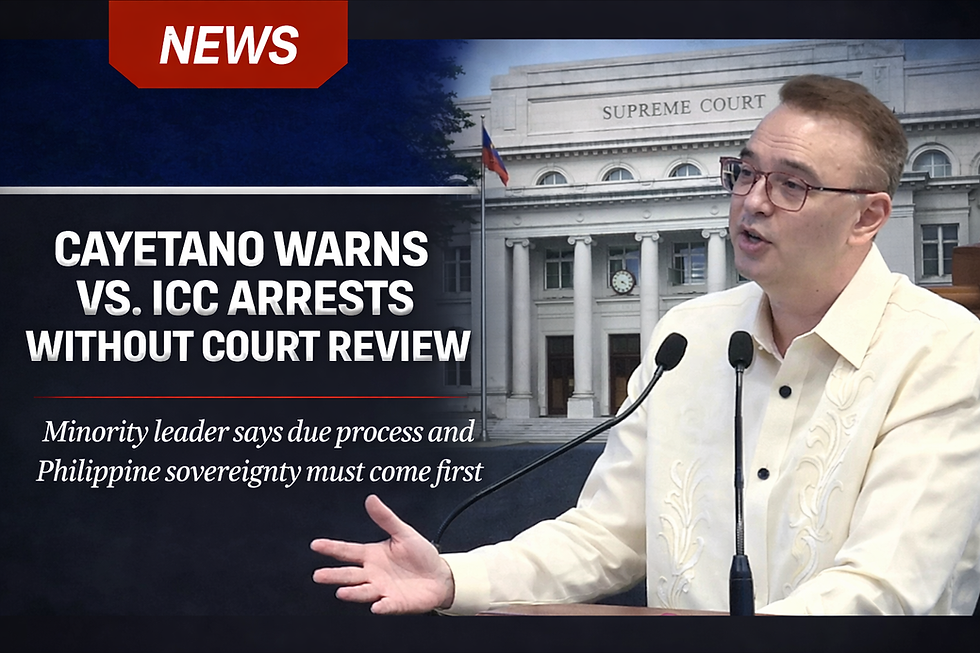
Senate Minority Floor Leader Alan Peter Cayetano raised strong concerns over the possible arrest and surrender of Filipinos to the International Criminal Court (ICC) without first going through Philippine courts, warning that such actions could undermine due process and national sovereignty.
Speaking on the Senate floor, Cayetano stressed that even the most basic principles of justice require authorities to ask questions and establish facts before acting. He cautioned that immediately sending a Filipino abroad could render unresolved legal issues “moot and academic,” depriving individuals of their right to seek remedies under local laws.
Drawing a parallel with the country’s firm stance on the West Philippine Sea, Cayetano said the same resolve should apply to protecting Filipino citizens. “We do not give up even an inch of our territory. The same principle should apply to our people—this is our country, and these are human beings,” he said.
The senator warned of a “dangerous precedent” if treaty obligations are used to justify arrests without judicial review, noting that treaties are still subject to interpretation and recognition by Philippine courts. He posed a scenario in which ICC warrants could be issued against high-ranking officials, members of the security sector, legislators, media practitioners, or even a sitting president—raising questions about whether the country would simply surrender its own citizens.
Cayetano also cited past conflicts, including the communist insurgency and the Marawi siege, warning that selective evidence or incomplete narratives could be used to trigger international cases despite complex on-the-ground realities.
He emphasized that sovereignty remains a cornerstone of international law, including the “generally accepted principles” often invoked in global legal frameworks. While acknowledging that crimes against humanity are a concern of the international community, Cayetano pointed out that the Rome Statute itself recognizes the primacy of domestic courts when a country is willing and able to investigate and prosecute.
“This is not about rejoining or not rejoining the ICC,” Cayetano clarified. “The issue—then and now—is simple: if a Filipino is arrested, that person must first have access to Philippine courts to seek remedy.”
The remarks reflect growing unease among lawmakers over how international legal mechanisms may intersect with domestic jurisdiction, particularly in politically sensitive cases involving former and current government officials.