
Iza Aldana
Apr 9, 2026
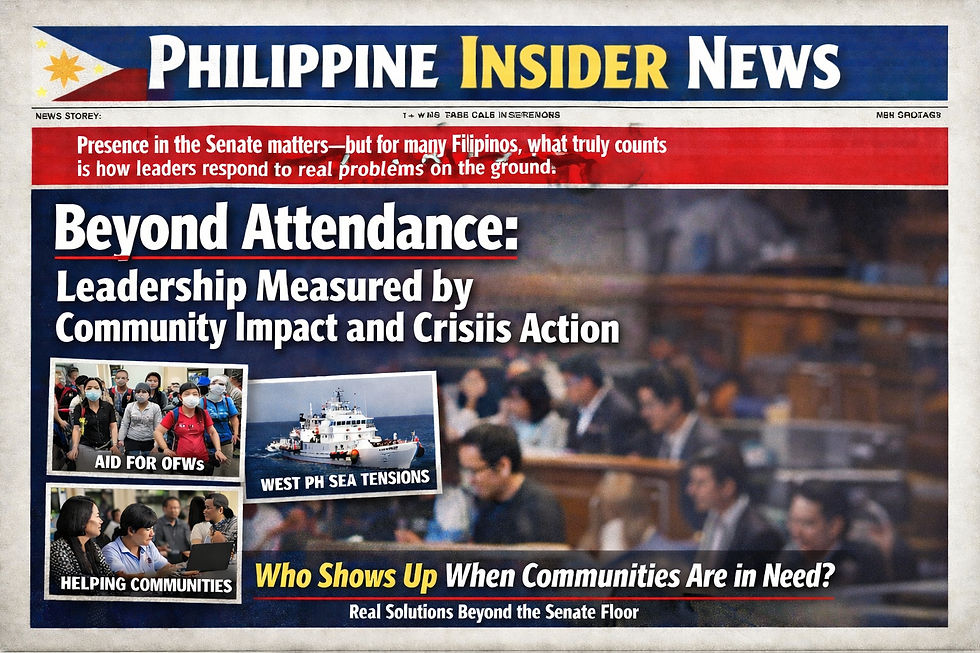
Presence in the Senate matters—but for many Filipinos, what truly counts is how leaders respond to real problems on the ground.
When Senate attendance records are released, public reaction is often immediate and unforgiving: present means productive, absent means ineffective. But for communities facing daily challenges, leadership is not defined by attendance alone—it is measured by outcomes that directly affect their lives.
Attendance remains important, as it reflects accountability to legislative duties. However, the true test of public service lies in what leaders accomplish both inside and outside the halls of power. Many critical efforts happen beyond formal sessions—through coordination with local governments, consultations with communities, and advance planning before crises escalate.
For instance, Alan Peter Cayetano has pushed for a national contingency framework amid rising tensions in the Middle East. For overseas Filipino workers and their families, this kind of preparation is not abstract policy—it can mean timely assistance, safer evacuations, and reduced uncertainty during emergencies.
He has also emphasized the need for better inter-agency coordination, a long-standing concern that often affects how quickly aid reaches communities. Disjointed responses and delayed action are not just bureaucratic issues—they translate to real hardship for families waiting for support during disasters or crises.
On the West Philippine Sea issue, a more measured diplomatic approach has been highlighted. Beyond geopolitics, this has implications for Filipino fisherfolk and coastal communities whose livelihoods depend on stability, access to resources, and the avoidance of heightened conflict.
At the community level, proposed measures such as expanding internet access, lowering transportation costs, and simplifying business processes aim to address everyday struggles. These are not just policy talking points—they impact students needing connectivity, workers dealing with high commuting expenses, and small entrepreneurs navigating red tape.
In many ways, the most meaningful work of governance is not always visible in attendance logs. It is found in policies that ease daily burdens, in preparations that prevent crises from worsening, and in decisions that prioritize people over optics.
Ultimately, the public’s question goes beyond attendance records: When communities are in need, who actually shows up where it matters most?